Where We’re Working: Anjuman I Taraqqī Yi Urdū Pākistān
Where We’re Working: Anjuman-i Taraqqī-yi Urdū Pākistān
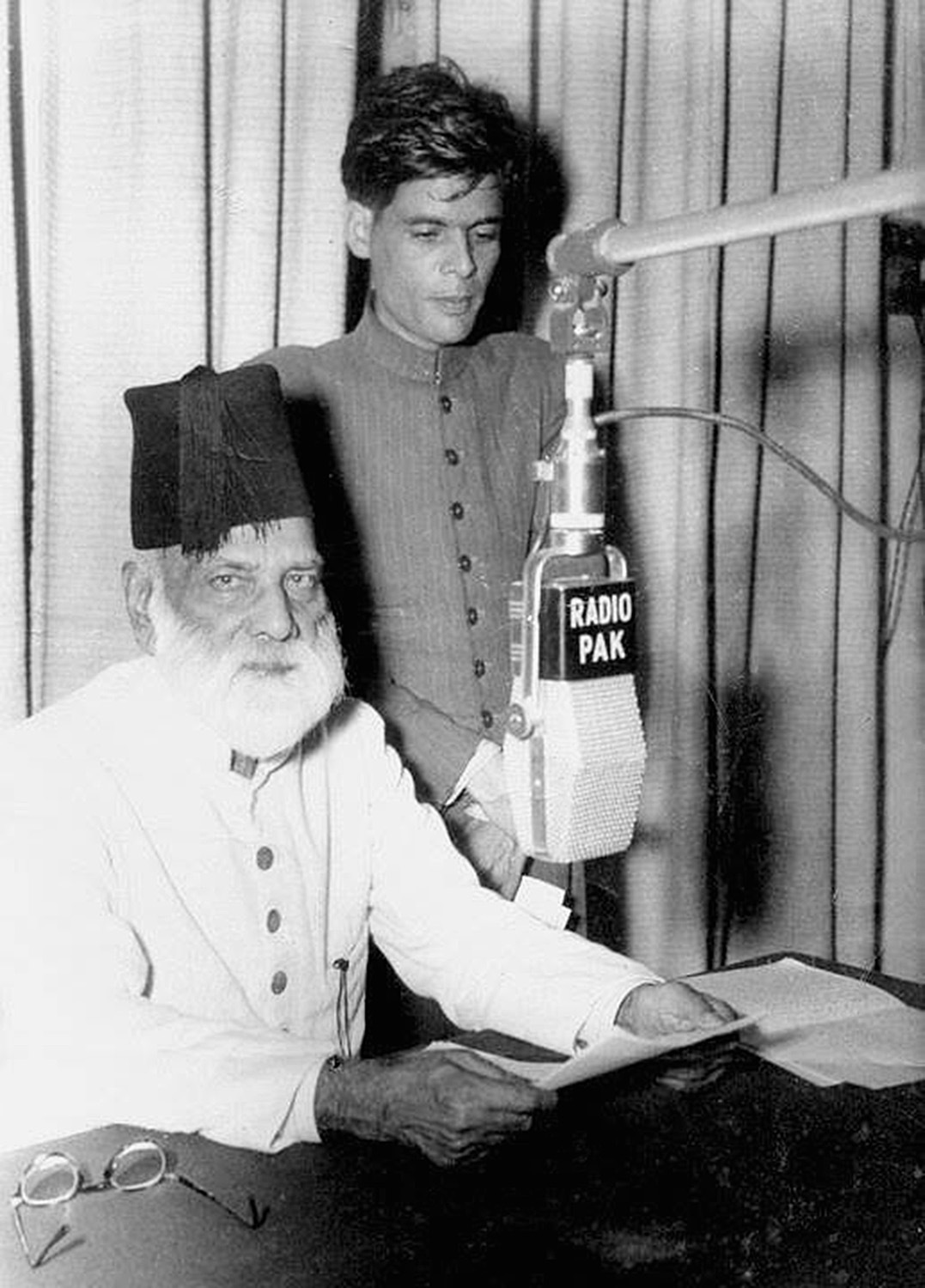
In November 1947, the Urdu scholar ʻAbdulḥaq (1869–1961) entered his library in Delhi for the first time since the independence and partition of India that August. He and his Anjuman-i Taraqqī-yi Urdū (Association for the Advancement of Urdu) had witnessed a momentous few months.
Millions of Indian Muslims fled to newly independent Pakistan in the face of riots and violence, while Hindus across the new border faced similar threats. A Hindu-owned insurance company, relocated from Lahore to Delhi, was given possession of the Anjuman’s library building to replace its lost office space. ʻAbdulḥaq hoped to find his library intact as he sought new locations for the collection.
The Anjuman had arisen out of the All-India Muhammadan Educational Conference, an effort to reform and modernize the educational system for India’s Muslims, centered on the northern city of Aligarh. In 1903, the Conference established a department for the promotion of Urdu language, literature, and culture—this grew into the Anjuman-i Taraqqī-yi Urdū.
In 1912, leadership of the Anjuman was turned over to ʻAbdulḥaq, whose lifelong work on behalf of Urdu later earned him the nickname of Bābā-yi Urdū, the Father of Urdu. ʻAbdulḥaq moved the organization to Aurangābād (now Chatrapatī Sambhājīnagara) in southern India, where he collected works in Urdu’s southern dialect, Deccani, to complement the more widely known dialects of the north.
ʻAbdulḥaq returned to northern India with the Anjuman’s infrastructure and library in 1938, settling in the capital city of Delhi. Less than 10 years later, the partition engulfed the organization in chaos. ʻAbdulḥaq described the events in a published account entitled Taqsīm-i Hind ke fasādāt aur Anjuman kī hijrat (“The riots of the partition of India and the migration of the Anjuman”), analyzed in Andrew Amstutz’s 2020 article “A Partitioned Library” (South Asia, volume 43, issue 3).
The Anjuman library was looted and most of the staff fled to Pakistan, with one scribe and his family killed in the violence. When ʻAbdulḥaq reached the library after three months, the situation was dire.
Sorting through the debris, ʻAbdulḥaq writes (translations by Amstutz) that “when we did not find any precious book or manuscript, its missing status broke our heart.” He acknowledges that this paled in comparison to the loss of life, asking “what sadness is due to those things when thousands, no, hundreds of thousands of precious lives have been hunted down with such oppression and cruelty.” Nevertheless, grief for the damaged library was also real: “in those torn pieces of waste paper, pieces of our heart can be found.”
As he and his colleagues salvaged what remained of the books and documents, a conflict arose between ʻAbdulḥaq and Abūlkalām Āzād (1888–1958), minister of education and the highest-ranking Muslim in the new Indian government. Āzād saw the Anjuman as a valuable part of the effort to maintain a Muslim cultural presence in partitioned India, and he wanted to maintain control of the collection even as he encouraged ʻAbdulḥaq to relocate to Pakistan for his own safety. For ʻAbdulḥaq, however, the culture and community of Urdu could not be contained within the borders of the partitioned states. He insisted that “I wanted to work in both places, rather, even farther than this, in Afghanistan, Iran, China, Arabia, Indonesia, etc.”
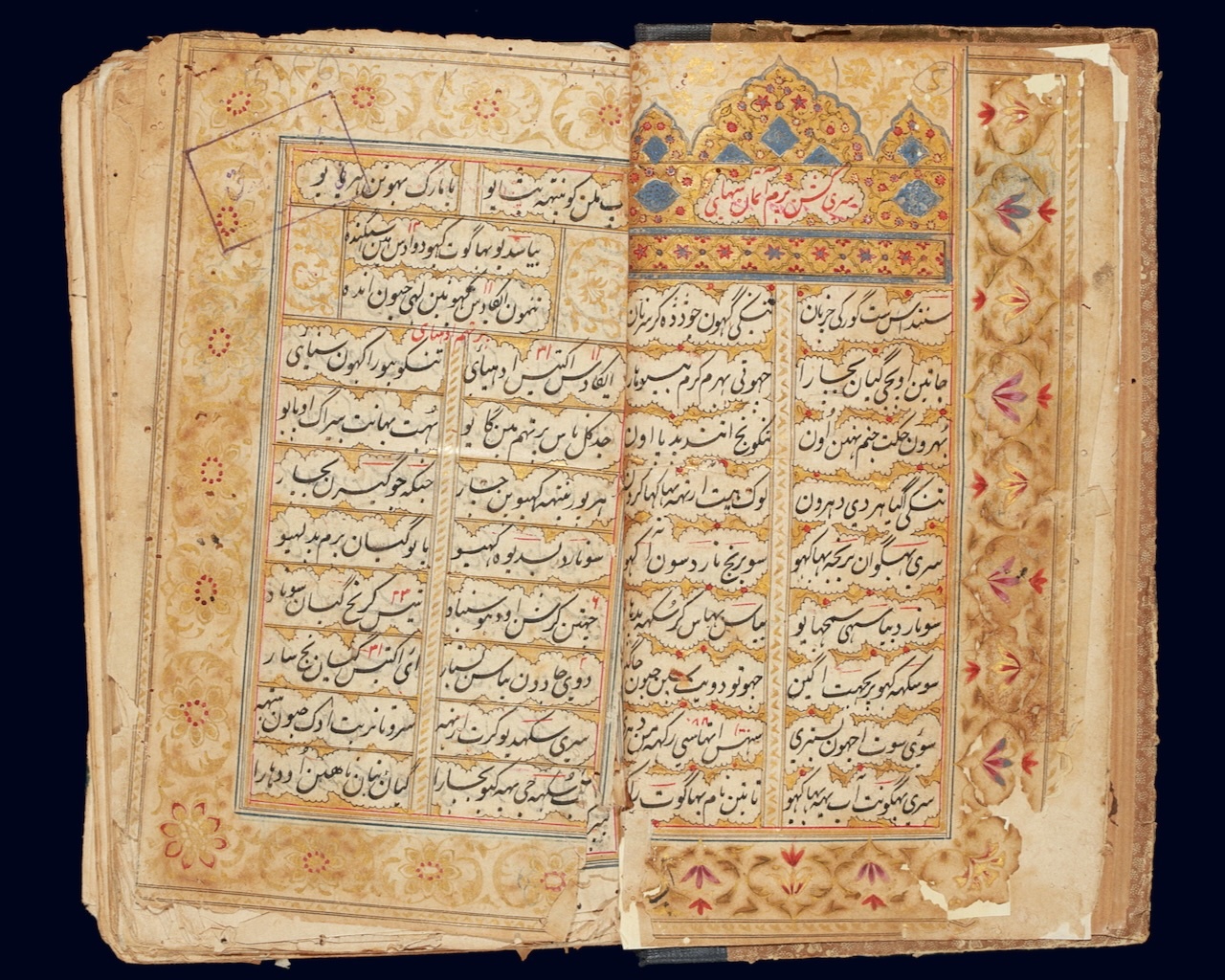
Ultimately, ʻAbdulḥaq separated his personal collection from the Anjuman’s institutional library and emigrated with his books to Karachi, the great port city near the mouth of the Indus River. There, he reestablished the Anjuman in Pakistan in early 1949. The remainder of the library was left in India and became the collection of the Anjuman in that country. The two organizations maintain a separate existence in Karachi and New Delhi today.
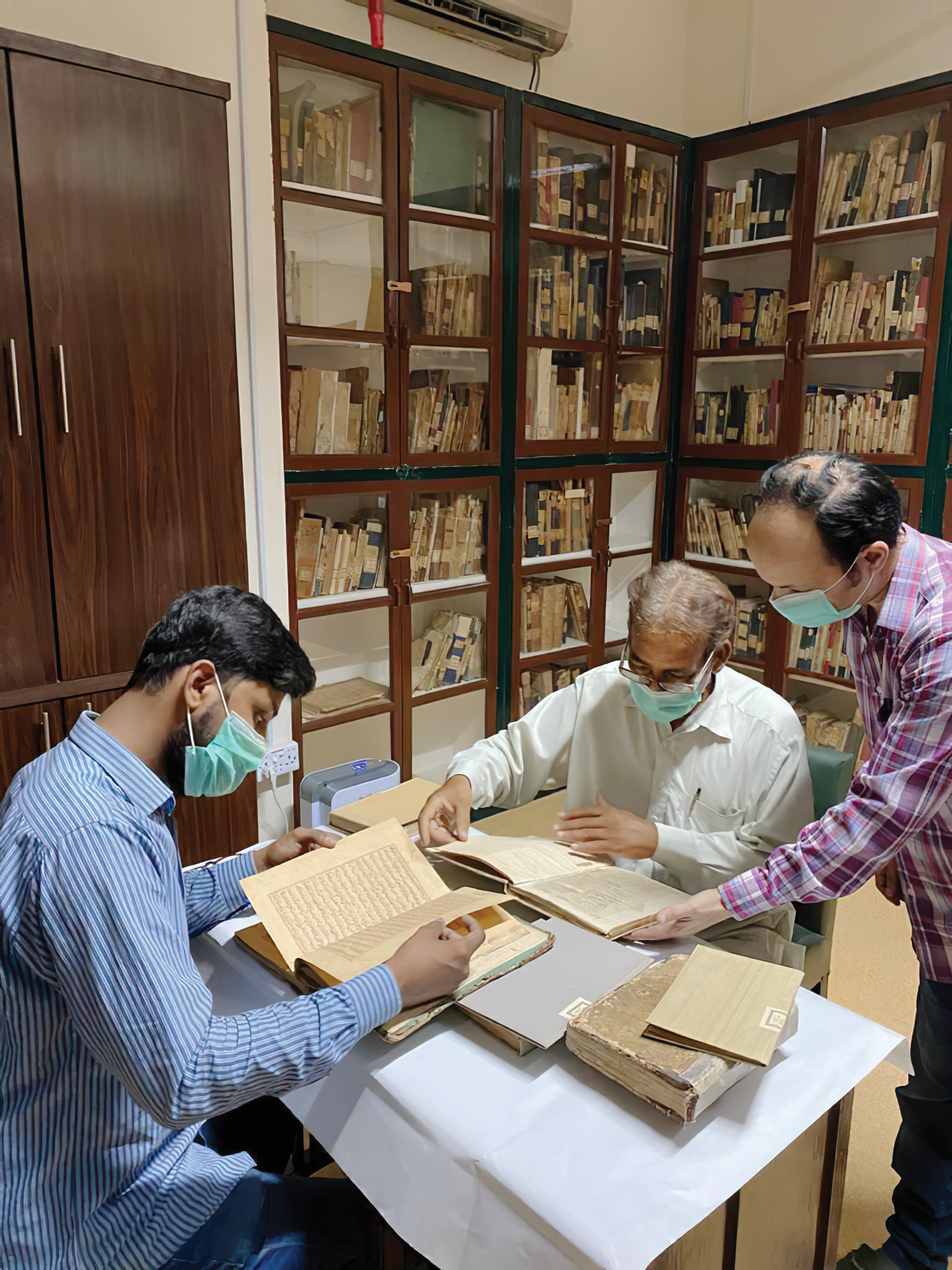
In 2020—early in HMML’s work with Islamic collections in South Asia—HMML began to photograph the collection of the Anjuman-i Taraqqī-yi Urdū Pākistān in Karachi (project code ATUP). It is now one of dozens of HMML projects that are underway in both Pakistan and India. Today, the Anjuman library in Pakistan includes approximately 2,000 manuscripts—mainly in Urdu, Persian, and Arabic—that are currently being digitized, cataloged, and added to HMML Reading Room. The online availability of the Karachi collection will help further ʻAbdulḥaq’s dream of enabling the study of Urdu language and literature across borders and partitions.
A version of this story originally appeared in the Winter 2025 issue of HMML Magazine.