Postscript — A Legacy Of Female Literacy
Postscript — A Legacy of Female Literacy
In 1994, HMML microfilmed the collection of manuscripts at the Herzogin Anna Amalia Bibliothek in Weimar, Germany. Among these was a prayer book accompanied by a set of 68 illuminations that were stored separately in a wooden box (HMML 47251). This unusual arrangement allowed for the illuminations to be viewed simultaneously with the prayer book’s text.
The illuminations depict scenes from the life of Christ, portraits of saints, and a portrait of the manuscript’s owner and commissioner: Margarethe von Rodemachern (1426–1490), a noblewoman whose life and family ties cross the modern-day borders of France and Germany.
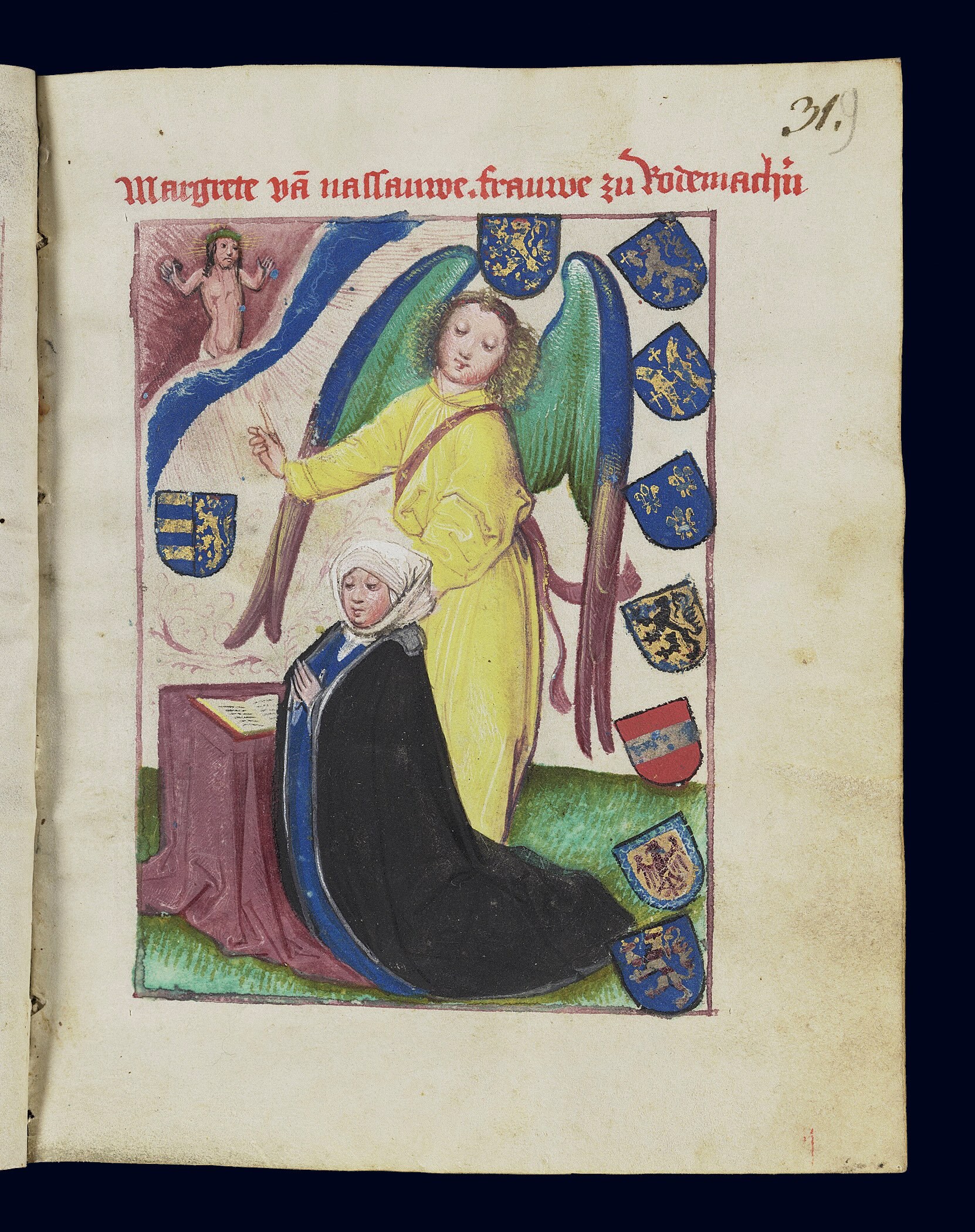
In her portrait, Margarethe kneels in prayer before a book while an angel guides her thoughts toward Christ. Coats of arms surround Margarethe, representing her marriage (front), her father (above), and the noble families of her father’s mother and grandmothers as well as of her political allegiances (behind). Above, text identifies her as “Margarethe of Nassau, wife [or lady] of Rodemachern.”
The prayer book was made when Margarethe was flourishing in her late 30s or early 40s and belonged to a literary circle of men and women from different social classes. Eventually, the book was given to her daughter—Margarethe, countess of Sayn-Wittgenstein—and remained with this branch of the family until it was acquired in 1770 by the Duchess Anna Amalia’s newly formed library.
In many ways, Margarethe participated in a family tradition of women sharing a love of literacy with the next generation. This is witnessed by another work microfilmed by HMML: Loher und Maller—an epic, fictive, founding story for the ducal family of Lorraine.
Marguerite de Joinville had the oral French original of Loher und Maller written down in 1405 when her daughter—who would become Margarethe’s mother, Elisabeth of Lorraine—was around nine years old. Later, Elisabeth had her mother’s verse epics translated into German and updated into the latest prose style. She commissioned this reworking of Loher und Maller when her daughter, Margarethe, was about 11 years old, perhaps making the story easier for her to read. In turn, Margarethe von Rodemachern had the story copied around the time her oldest daughter was turning seven.
In all, three generations of women undertook the project of transcribing, translating, and transforming a literary work that was important to their family’s sense of identity and history—each when their daughters were learning to read and were only a few years away from becoming women themselves, in an era when virtually no European women were producing secular texts.
Although the prayer book and Loher und Maller were dispersed to different families, libraries, and archives, images of both are reunited in HMML’s microfilm collection (including two copies of Loher und Maller: HMML 36166 and HMML 16088). In preserving this legacy of female literacy, HMML also participates in the shared vision of these women to make cultural heritage accessible to the next generation.
A version of this story originally appeared in the Winter 2025 issue of HMML Magazine.